About Our Dominant
Blue Eyed Breeding Program
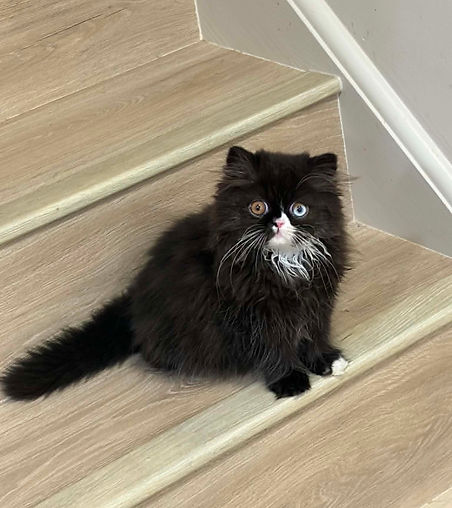
Dominant blue-eyed cats are stunning. Not only do they possess an enchanting appearance, but they can also have gentle and affectionate temperaments, making them wonderful companions. In our experimental TICA/CFA DBE program, we focus on improving type and developing cats as closely as possible to the Persian standard.
Many breeders and lovers of blue-eyed cats wonder: what is so special about a blue-eyed cat with a dominant blue eye gene and where does it come from?
Understanding Blue Eyes in Cats
Blue eyes in cats can occur through several different genetic mechanisms. They are not all caused by the same gene or mutation.
In colorpoint cats, blue eyes are associated with the temperature-sensitive TYR (tyrosinase) pathway, commonly referred to as the cs allele. This is the familiar mechanism responsible for the blue eyes seen in Siamese-type colorpoint cats.
Blue eyes can also occur in cats with dominant white or white-spotting phenotypes. These traits are associated with variants affecting the KIT gene and can interfere with the development and distribution of pigment-producing cells during embryonic development. Depending on the individual cat and the extent of pigmentation affected, this can result in one or two blue eyes or heterochromia.
However, dominant blue eyes (DBE) are different.
DBE describes a phenotype in which a cat may have one or two blue eyes, heterochromia, and often little or no obvious white spotting. Scientific research has now demonstrated that DBE is genetically heterogeneous — there is not one single “DBE gene.” Different feline DBE lineages can be associated with different genetic variants.
Several DBE-associated variants have now been identified, including variants involving PAX3. The 2026 study identifying the Marusya mutation further expanded our understanding of this genetic diversity and identified the specific DBE^MARU variant associated with the Marusya lineage.
This distinction is extremely important. Two cats may both have dominant blue eyes while carrying different genetic variants and belonging to completely different DBE lineages.
For this reason, in my breeding program I do not treat all blue-eyed cats as genetically equivalent. I am specifically working with the Marusya DBE lineage and the genetic variant now identified as DBE^MARU.
In cats with a dominant gene, the deep blue color of the eyes is combined with the non-white colors of cats. That is, it can be a black, red cat with turtles with blue or differently colored eyes. This phenomenon is explained by a unique natural mutation. These unusual cats win the heart at first sight and forever.
Our Marusya DBE Cats
A rare genetic line that became part of my breeding journey
My work with dominant blue-eyed Persian and Exotic cats did not begin with a desire simply to produce blue eyes.
It began with a fascination with something rare — and with a particular genetic line that I believed deserved to be understood, preserved, and developed responsibly within the Persian and Exotic breeds.
For approximately five years, I have been developing my Dominant Blue Eye (DBE) breeding program, with a special focus on the Marusya line from Russia.
Marusya is not simply a name in a pedigree to me. She is the foundation of a genetic line that I have followed closely, studied, and worked with in my own breeding program. Marusya is the grandmother of my cats, and I have had the opportunity to work with this lineage directly rather than simply purchasing cats described as “blue-eyed” and assuming they all carry the same mutation.
That distinction is extremely important.
There is not just one “DBE gene”
For many years, dominant blue eyes in cats were discussed almost as though they represented one genetic trait.
We now know that this is not the case.
Scientific research has demonstrated that different feline families can have different genetic mutations that produce dominant blue-eye phenotypes. Therefore, it is not scientifically correct to assume that every blue-eyed cat belongs to the same genetic line.
The Marusya lineage is one of these distinct lines.
And in September 2026, an important scientific breakthrough finally gave us a molecular explanation for what breeders had observed in this family for years.
The Marusya mutation has now been identified
A study published in Animal Genetics in 2026 — “Additional PAX3 Variants for Dominant Blue Eyes in Cats” — identified the genetic variant associated with the studied Marusya family.
The variant is located in the PAX3 gene:
PAX3 XM_019838731.3: c.784C>T
p. (Arg262) *
The researchers designated this variant DBE^MARU.
This is a stop-gain (nonsense) variant, and the study found it in Marusya as well as in the DBE offspring studied from her family. The inheritance observed in this family was consistent with an autosomal dominant pattern.
This is an important moment for breeders working with the Marusya line because what was previously recognized primarily through pedigree, phenotype, and breeding history can now also be identified at the molecular level.
What makes the Marusya line especially interesting
One of the things that fascinated me about this line from the beginning was that the expression of the trait is not always identical.
Some cats have striking blue eyes.
Some have heterochromia.
Some may have a much less obvious expression.
And some cats may carry the genetic variant without displaying the characteristic blue-eye phenotype in an obvious way.
The 2026 study provides scientific support for this variable expression within the Marusya family.
This is one reason why I have always been cautious about judging a cat's genetics solely by looking at its eyes.
A beautiful blue-eyed cat is the visible result of genetics.
But the genetics themselves are not always visible.
My work with the Marusya lineage
When I began working with this line, there was no commercial genetic test that could simply tell a breeder, “This cat carries the Marusya mutation.”
There was also no molecular identification of the mutation.
Breeders were working from pedigrees, breeding history, phenotype, and careful observation.
I chose to work with the Marusya lineage because I wanted to understand it and incorporate this rare trait into Persian and Exotic breeding while continuing to select for breed type, health, temperament, and quality.
This has never been about producing blue eyes at any cost.
For me, the blue eyes are only one part of the story.
My goal is to produce beautiful Persian and Exotic cats that are first and foremost healthy, well-balanced, affectionate, properly developed, and as close as possible to the breed standard — while carrying this unusual genetic trait.
From Russia to my breeding program
The Marusya lineage originated in Russia and subsequently became part of breeding work involving Persian, Exotic and other cats.
My connection to this line is personal: Marusya is the grandmother of my cats, and I have worked directly with descendants of this family.
That gives me a particular interest in preserving the integrity of the line and understanding exactly what I am breeding rather than treating all dominant blue-eyed cats as genetically interchangeable.
The identification of DBE^MARU in 2026 is therefore especially meaningful to me.
It confirms that the unusual inheritance pattern breeders observed in this family has a specific genetic basis.
Responsible breeding matters
The discovery of a mutation does not automatically tell us everything about it.
This is especially important with a newly characterized genetic variant.
The 2026 study reported one abnormal kitten from a DBE × DBE mating that was homozygous for the DBE^MARU variant and died at birth. This observation means that the consequences of carrying two copies of the mutation deserve careful attention and further study.
For me, this is exactly why responsible breeding must always come before appearance.
I will continue to follow the scientific literature as new information becomes available and make breeding decisions with the health and welfare of my cats as the priority.
There is still much to learn about DBE^MARU — including its complete range of phenotypic expression and the long-term implications of different genotypes.
Why this matters to me
I have always believed that breeding is more than producing kittens.
It is preserving something.
It is learning.
It is making decisions today that affect generations of cats that have not yet been born.
When I look at my Marusya-line cats, I don't see simply an unusual eye color.
I see a piece of a rare genetic history that traveled from Russia into my breeding program — and an
opportunity to continue studying and developing that line within the Persian and Exotic breeds.
The 2026 discovery of DBE^MARU gives this work a new scientific foundation.
And I am proud that my cats are part of this continuing story.
I am not breeding blue eyes simply because they are rare. I am working to understand, preserve, and responsibly develop a rare genetic trait while never losing sight of what matters most: the health, beauty, temperament, and quality of the cats themselves.

Let's Explore The Details
At Neobea Shadow cattery, we are dedicated to advancing feline genetics while prioritizing the health and well-being of our cats. Alongside producing extraordinary EXO LH and EXO SH cats, one of our most exciting projects is the dominant blue-eye breeding program. This initiative focuses on introducing striking blue eyes into the Persian cat breed, reflecting a commitment to creating visually stunning yet healthy and robust companions.
While innovating with genetics, we recognize that myths and misconceptions often surround the blue-eyed gene. In my own breeding program, I have not observed health concerns that I can attribute to the DBE phenotype or the Marusya line. I nevertheless continue to follow scientific research closely, particularly as the effects of different genotypes are still being studied.
The genetic variants used in the dominant blue-eye program are naturally occurring feline genetic variants. My breeding decisions prioritize the health and welfare of my cats, and I continue to follow emerging scientific research as our understanding of these variants develops. Every kitten undergoes a thorough veterinary examination, and I carefully select breeding cats with attention to health, temperament, structure, and breed type.
This breeding program is continually evolving, with each generation carefully selected to refine desirable traits and enhance the true Persian type. This process requires expertise, patience, and meticulous planning, but the results promise to be remarkable.
As breeder, I take pride in producing healthy, well-rounded cats. Each cat is the result of thoughtful genetic analysis, with a focus on overall health and temperament alongside their stunning blue eyes. This approach ensures that every kitten is not only a unique and beautiful companion but also a healthy and loving one. These cats, with their dominant blue eyes, are not just a project or a program. They are the most incredible adventure I have ever experienced in breeding — a journey filled with uncertainty, passion, hope, and pure wonder.
We are pleased to announce that we showed our EXO LH / Persian DBE cat for the first time at the CFA show in America and this is our Neobea Shadow Patrick. He is now a CFA champion and has even started collecting his Grand Champion points. The show was in St. Charles, IL in March 2026.
Contact us today to explore our available blue-eyed kittens. Discover rare and extraordinary companions who stand out for their beauty, health, and exceptional charm.
DBE Cats